Grapefruit Blues

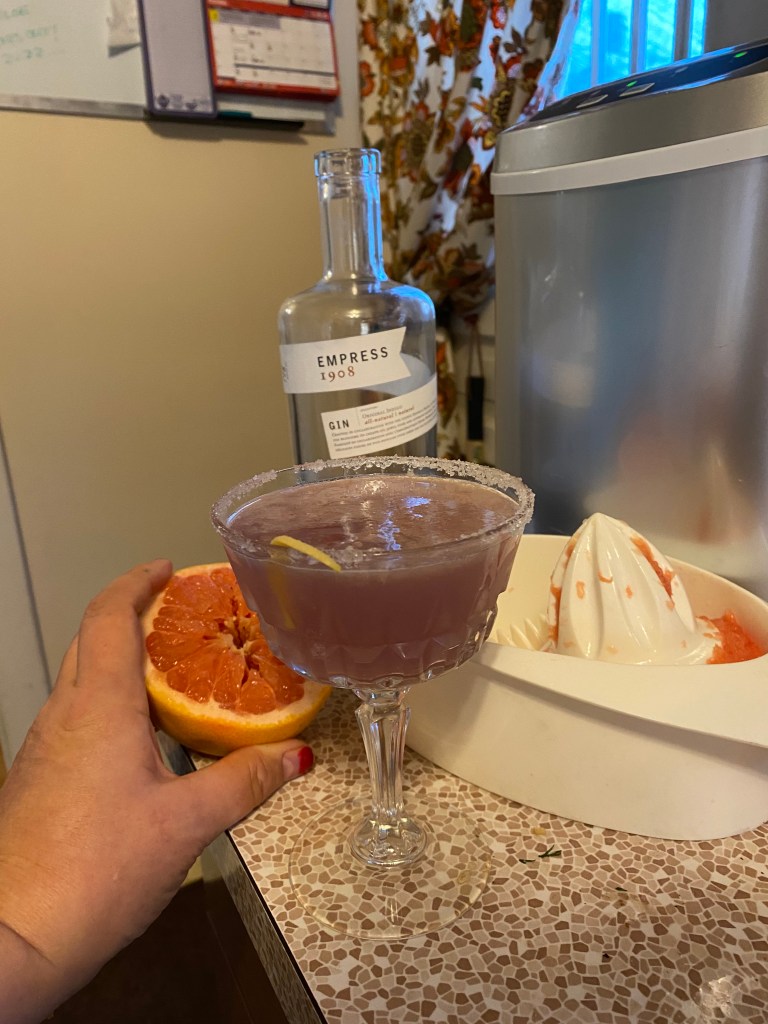
I was immediately entranced by Empress 1908 with its majestic bottle and deep blue colour. I enjoyed its smooth citrus aroma that at first I couldn’t identify — not lemon, lime, or orange. And it’s lovely in light drinks, even sours.

But I became frustrated as I tried to work with it in stronger cocktails, as it just didn’t measure up. Fortunately the distiller provides some cocktail recipes, some of which involve obscure ingredients, but with enough variety to give this amateur mixologist some direction to work with. I noticed that they often garnish with a grapefruit slice — a big garnish and likely to impart some serious flavour. So I tried their own gin and tonic that way, and it’s really nice. I’d certainly serve it to grapefruit fans, including myself.

The mystery citrus turns out to be grapefruit and I wondered why their recipes didn’t include a Salty Dog or anything actually featuring grapefruit juice. Would it overwhelm? Yeah, it did, even with 2:3 gin to juice. And the colour was quite murky, not a totally unattractive mauve, but it would need to be garnished well and I missed the usual beautiful colour of a salty dog — similar mauve results in the Gin Basil Smash. Better colour might come from a white grapefruit, but those are out of fashion now and hard to find, and really the Empress flavour didn’t stand up well in the Dog.
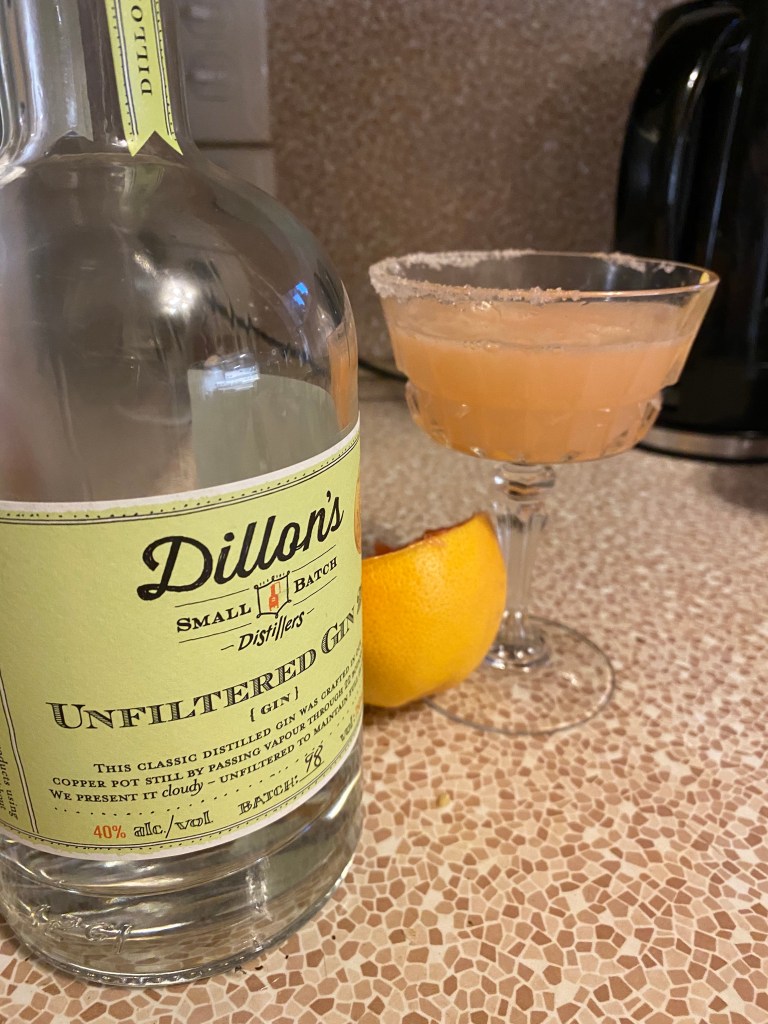
To check my recollection of how a salty dog can taste and so I tried one with my stand-by flavourful gin, Dillon’s Unfiltered 22. That was more like it, via both senses.
I’m still hoping to try the Empress 1908 recipe for Cucumber Blue, which looks promising and will preserve the gorgeous blue from the butterfly pea flower, and it seems the Empress has just posted some new and more accessible cocktail recipes. Good on them for that! One drink does not fit all gins. Gins are so varied now that recipes — or even suggested complements — help us make the best of them.

Gifts 2020

The Winter holiday season is coming up and this year most of us can’t socialize indoors with extended family and friends as we would like. But there will be modified visits and gifts. Where you might ordinarily give a bottle of wine as a host gift, for just a little more money you can give a far more interesting gift of a small bottle of Canadian artisanal gin. 375mL bottles are available from some of the best distillers who delivery directly, meaning it’s available to everyone across the country. So support small Canadian distillers! And order early as the shipping streams may get extra clogged this holiday season.

I love that each of these gins also has a strong terroir element, expressing the botanical and agricultural environment of their origins. Find a gift for your friend from West coast with Schramm’s or Evolve, and for those from the West Coast, Gin Royal, or one of the other options from Compass Distillers. Full reviews for each of these are in progress here at Gin Social.

  1. Schramms’s is probably the best Canadian gin, and inexpensive too! Herbal, smooth, even luscious — with a particular body and what I can only call a yumminess from the potato base. You can’t go wrong with this one. I bought a few small bottles in the Summer to justify the shipping costs for tasting from larger bottles. (Fortunately the base price is low.) Only one of those gift-sized bottles actually became a gift and the rest were used to host people for outdoor socializing — always making a sensation. Schramm’s makes the most amazing hot toddy, especially if you use fresh bay cordial as your syrup and lime instead of lemon. Schramm’s also demonstrates one of the newest trends in gin — the herbal — and it may be unlike anything you or your friends may have had but it’s still clearly a gin. Such new herbal flavours inspired the innovation of a sixth division on the flavour diagram for The Gin is In.
  2. Gin Royal from Compass in Nova Scotia, who also offer sample-sized bottles suitable for a couple of drinks. They have 6 gins plus a Genever, and I’ve barely cracked the range, but Gin Royal seems to be their headliner and it is interesting and pleasing in multiple ways. Terroir elements come from local botanicals and touches of honey and royal jelly. The flavour is lightly spicy and the blue colour, from butterfly pea flower, makes for all sorts of fun cocktail play — as much for the bartender as for the imbiber.
  3. Another blue gin, with a different terroir expression, is Evolve Gin, with a base spirit distilled from Okanagan apples. It’s probably the fruitiest gin I’ve tasted yet. Although the apple base remains in the background to its floral and herbal elements, that fruitiness lends an excellent character to cold-weather drinks. The other Okanagan gins are available in 375mL too, and so far I quite like them. But Evolve has my heart: it plays charmingly on its colour changing properties with a gender equality theme. Feminist gin! I’m sold.

All of these make great Hot Toddies or Negronis, because (say it with me) gin is not just a summer drink! And for New Year’s they are great in a French 75.

Setting standards

With the help of Ed V Creative, we now have graphics for gin ratings and price-points, and a page explaining them. Please visit it and let me know in the comments here if you think the system needs tweaks.

The ratings are influenced by the systems at The Gin is In, the Rumhowler, and In Search of Elegance. I have kept it simple because I don’t (yet) have the palate to make finer distinctions. You may disagree even with these rough distinctions — please let me know in the comments.

Whenever I post reviews, which are on pages that won’t allow for comments, I will also have related blog posts where we can have discussion, or you can write to us directly. Perhaps you can persuade me! I’d love that.

I’m not sure I have the nerve to give anything 5 stars, but hopefully you can help me learn.

Spiced Gins

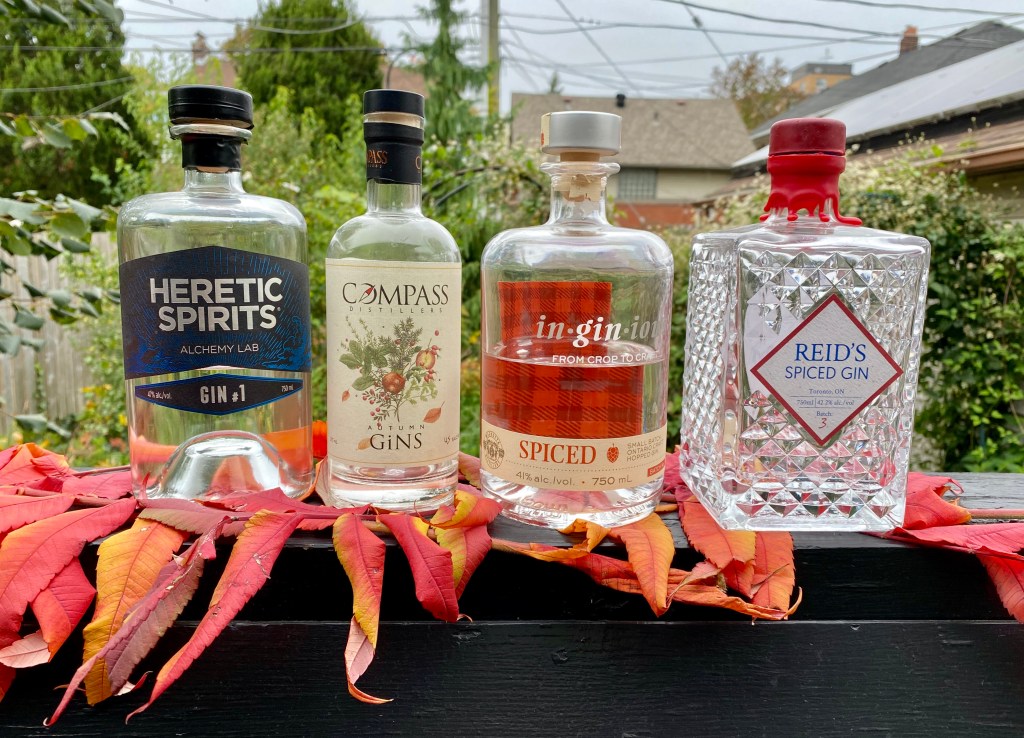
Juniper is a spice, of course, and essential to the classic gin taste. But the new gins allow for experimentation with all sorts of other spices. I have yet to see a “pumpkin spice” gin, but some of these come pretty close. Perhaps they are more like “chai gins” since cinnamon or cassia always plays a big role. While that flavour is pretty common in gin, to stress it suggests they are Fall or Autumn gins, and so I consider the spiced gins from both Magnotta (Inginious) and Reid’s in Ontario alongside the Autumn GiNS from Compass in Nova Scotia. Any of these makes a great Tom Collins or, even better, a hot toddy (which I’m starting to think of as a Hot Collins). They’ll warm up your thermos for outdoor socializing.

Starting with the spiciest!

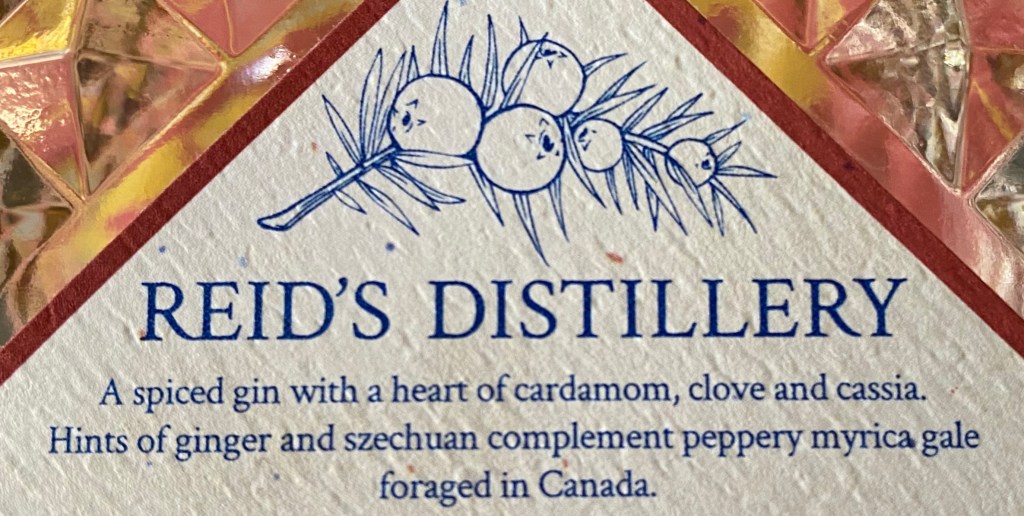
Reid’s Spiced Gin, the spiciest of the lot, with all the intensity and range that you could want in a gin. It is my favourite so far for a hot toddy and so I demolished the bottle by making outside drinks for friends. Admittedly, on its own, Reid’s sometimes has a soapy taste reminiscent of Old Spice, which means that this one is for cocktails only, but it makes those cocktails pretty exciting.

Inginious Spiced Hopped Gin from Magnotta also makes a great hot toddy and it’s more adaptable than Reid’s, combining a solid dose of cinnamon with hops that rounds it out.

Both Reid’s and Inginious can be bitter and the G&T needs to be softened with a big citrus squeeze or fruit bitters — I tried Dillon’s Pear and their house Aromatic DSB. Simpler and more effective are the tonic syrups that offer robust citrus, my favourite so far being Porter’s Cardamom and Orange Tonic Syrup. (You can make a hot G&T with these too! More to come on that.)

The one gin explicitly themed by the season, Compass Autumn GiNS can substitute across the menu for your regular gin, including in a Bramble. It already has its own berry notes that together with the spices alongside the spices give it a taste of berry crisp — so much fun.

If you are shy of committing to a whole spicy bottle, consider Heretic Gin #1 which is an all-purpose gin but features a distinctive cinnamon finish that will give that autumnal kick to your hot toddy.

Full reviews on all four gins to come soon.

Let’s travel!

Travel is really limited in the days of SARS-CoV-2 but we still have mail, and lots of great small distilleries across Canada doing interesting new things! Artisanal gins have become my COVID obsession and I hope to share this with you. The blog posts will allow for comments and I really do hope to hear from you!

When I started exploring Canadian artisanal gins in May, I started as locally as I could, in Ontario, but as I’m beginning to recognize and figure out how to access the range of these gins, I’m now organizing myself East to West, but also prioritizing distilleries that provide free or inexpensive delivery. (Please let me know if you know of such places, and they’ll go to the top of my list!) So, my first gin review is of Kazuki Gin from Sheringham Distillery on Vancouver Island.

The East-West
travel plan

I’m in Ontario where the LCBO, so I understand, provides the world’s largest liquor monopoly, and this can be good and bad. This means access to lots of interesting things but it makes certain things impossible to get. Crème de violette is a case in point. I will never be able to make an Aviation cocktail properly without it! I suppose we can order by the case — here, the power of the monopoly, but I don’t see that in my future.

Despite the lack of crème de violette — and crème de mûre for a traditional bramble (though it looks like I could make my own) — there are all sorts of interesting flavours to sample in the recently surge of artisanal gins across Canada. As many of them aim to capture the character of their region, sometimes going so far as to use only local or even on-site ingredients, it’s like having regions of Canada travel to you! In the case of Kazuki, that means a pan-Pacific taste of Japanese cherry blossoms and green tea, to excellent effect.

This second post marks my official launch, and I’ll be filling this site gradually with reviews of Canadian artisanal gins, other reviews, and some commentary. Book yourself in!